
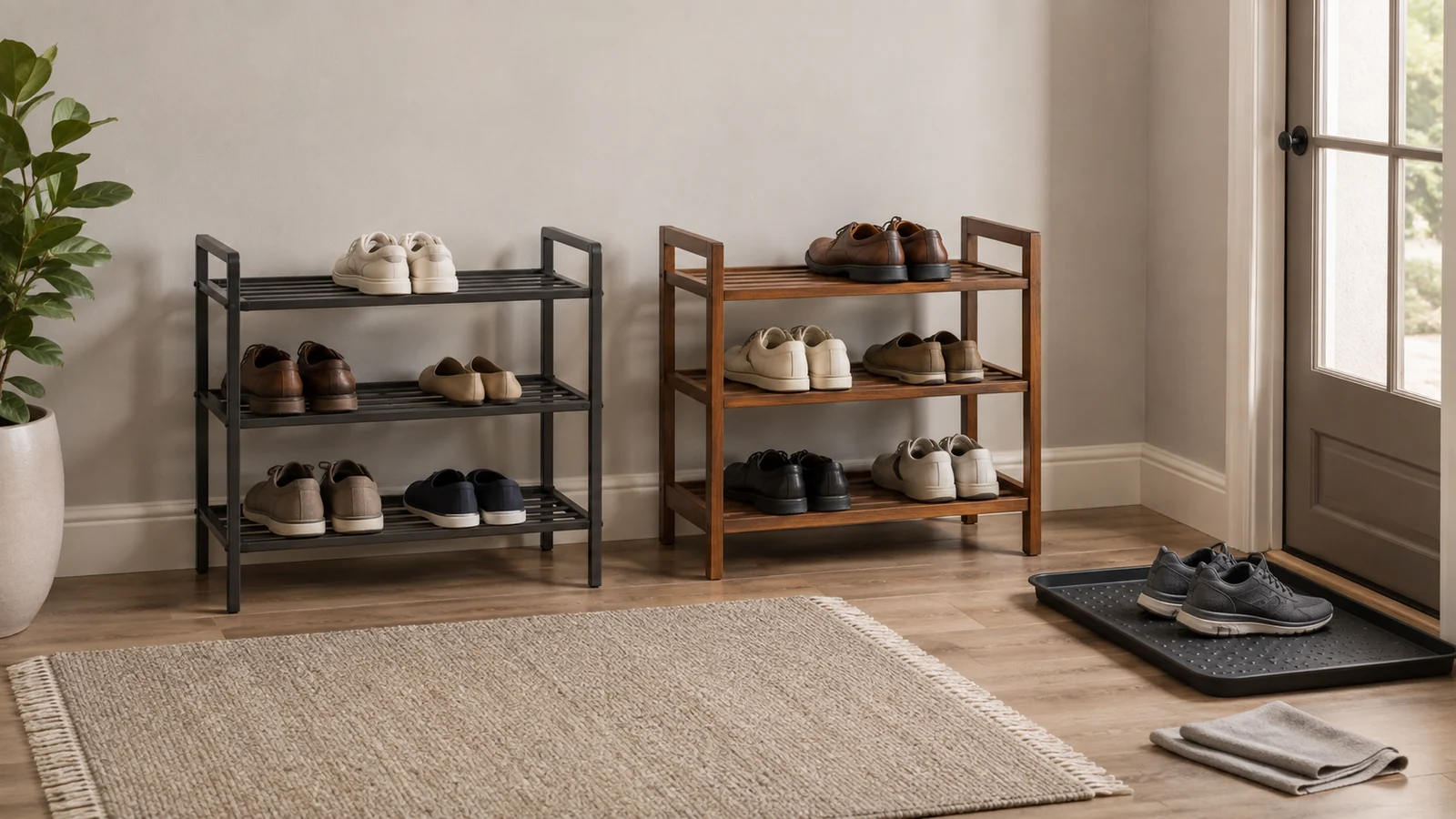
Metal is not automatically better than wood for a shoe rack. Choose only after you identify the exact substrate, coating or finish, footwear-contact surface, exposure routine, and care instructions. A coated-steel rack may fit a routine that calls for a documented coated surface and wipe-down boundary. A solid-wood, veneer, plywood, MDF, particleboard, or laminate rack may fit a different finish and contact preference, but those construction types are not interchangeable. If the exact documents do not address your routine, choose either pending exact evidence rather than choosing from the material label.
What the material label leaves out
“Metal” and “wood” are discovery labels, not performance classes. Wood exchanges moisture with its environment, but that general mechanism does not set a wet-shoe limit for a finished rack. Wood-based products can differ in construction, moisture response, and finish; verify the exact rack’s material and care instructions. Treat solid wood, veneer, plywood, MDF, and particleboard as different construction questions. Laminate is a surface system, so identify its underlying core as well.
For a coated-steel rack, protective-coating performance depends on coating integrity; penetration or damage can compromise corrosion resistance. That is a coated-steel mechanism, not a prediction about every metal rack, alloy, paint, powder coat, or exposed edge. The exact manufacturer care document controls cleaner, chemical, standing-water, repair, load, assembly, anchoring, and finish boundaries.
Use the exact rack documentation to verify material, finish, and care. General material-family behavior does not establish wet-shoe limits, cleaner compatibility, or finished-rack performance.
Decision matrix: compare the exact surface, not the category
Use this matrix before comparing rack styles. “Pending” is a valid result. It means the product page or manual has not supplied enough evidence for that row.
| Question | What evidence can establish | Likely implication | Skip condition | Unknown flag |
|---|---|---|---|---|
| Wet exposure | Exact substrate, coating or finish guidance for dry indoor use, damp footwear, splash, or repeated wet contact. | Choose a material direction only when documented surface guidance addresses your routine. | No exact document addresses the exposure. | “Metal” or “wood” only. |
| Cleaning tolerance | Manufacturer-approved cleaner, method, contact time, and restrictions. | Follow the stated care boundary instead of assuming one material is easier to clean. | You would need to choose a chemical or method not documented for the exact finish. | No care page or manual. |
| Finish damage | Finish or coating type, exposed edges, and instructions for damage or repair. | For coated steel, inspect coating integrity in the evidence; for wood-family products, identify the surface and core. | Damage, exposed substrate, or repair boundary is unclear. | Finish named only as “wood” or “metal.” |
| Weight and handling | Exact assembled weight, dimensions, handling instructions, and whether you can move that configuration. | Use handling as an exact-product question. | You are using material name as a proxy for weight, portability, stability, or load. | Only material family is known. |
| Footwear contact | Whether shoes touch a finished shelf, coated tube or wire, exposed edge, or another surface. | Evaluate the exact contact surface and its care boundary. | Contact points or finish are not shown or documented. | Product photos hide contact areas. |
| Maintenance | Routine care, inspection limits, standing-water restrictions, and finish-specific instructions. | Choose only when the documented routine fits what you can maintain. | Maintenance depends on an invented cleaner, drying rule, repair step, or odor promise. | No exact maintenance instructions. |
Use this decision tool before you shop
- Record exposure. Mark your routine as dry indoor, damp shoes, splash, or repeated wet contact. Do not turn that label into a waterproofing or drying claim.
- Identify construction. Record base metal and protective treatment when applicable. For wood-family products, distinguish solid wood, veneer, plywood, MDF, particleboard, and laminate plus its core.
- Read care limits. Find the exact manufacturer instruction before choosing a cleaner, chemical, abrasive, standing-water practice, repair method, or refinishing step.
- Trace footwear contact. Check whether shoes rest on a finished shelf, coated tube or wire, or exposed edge. If contact is unclear, mark the row unknown.
- Separate handling from safety. Ask whether you can handle the exact assembled configuration. Do not use material as evidence of stability, load, capacity, anchoring, child suitability, or pet suitability.
- Choose an output. Use metal direction only when exact metal, coating, and care evidence addresses your routine. Use wood-family direction only when the exact substrate, surface system, and care evidence do. Otherwise choose either pending exact evidence or skip until verified.
When metal is the better direction
Choose a metal direction when the exact rack documents its base metal or relevant construction, identifies its coating or exposed surfaces, and gives care guidance that fits your entryway routine. For coated steel, the evidence question is coating integrity. A damaged or penetrated barrier can change the corrosion-protection boundary, so do not treat a coating label as a universal result.
Skip the direction when the listing says only “metal,” hides cut or welded edges, or supplies no care instruction for the exposure and contact surfaces you need to manage.
When wood-family construction is the better direction
Choose a wood-family direction when the exact product identifies the substrate and finish system, explains the relevant care boundary, and fits the footwear-contact and exposure questions in your matrix. Wood exchanges moisture with its environment, but that fact does not establish how a finished rack will respond to damp shoes. Veneer, plywood, MDF, particleboard, and laminate need their own evidence.
Skip the direction when “wood” is the only construction detail, the core is unknown, the finish is not identified, or the care instructions do not address your routine. Do not substitute a generic cleaner or wet-shoe rule.
Keep safety and fit outside this material matrix
Material choice does not establish stability, load, capacity, anchoring, child suitability, or pet suitability. Those questions belong to the exact rack manual, supplied hardware, wall condition, and installation context. If anchoring is part of the exact product instructions, follow those instructions and applicable qualified guidance. Do not use this article to prescribe an anchor or infer a load limit.
For a different storage-type decision, see shoe cabinet versus shoe rack. If your main problem is walking-path space, use the narrow-hallway clearance workflow. For a post-install tipping problem, use shoe-rack tipping guidance rather than treating material as a safety shortcut.
Bottom line
Choose metal or wood-family construction only after the exact surface system and care instructions answer your wet exposure, cleaning, finish-damage, handling, footwear-contact, and maintenance questions. If they do not, choose neither from the label alone. Keep safety, load, stability, anchoring, and clearance as separate exact-product decisions.